

Blog
Is Vaping Better Than Smoking? A Complete Evidence-Based Guide
Understanding the Difference Between Vaping and Smoking
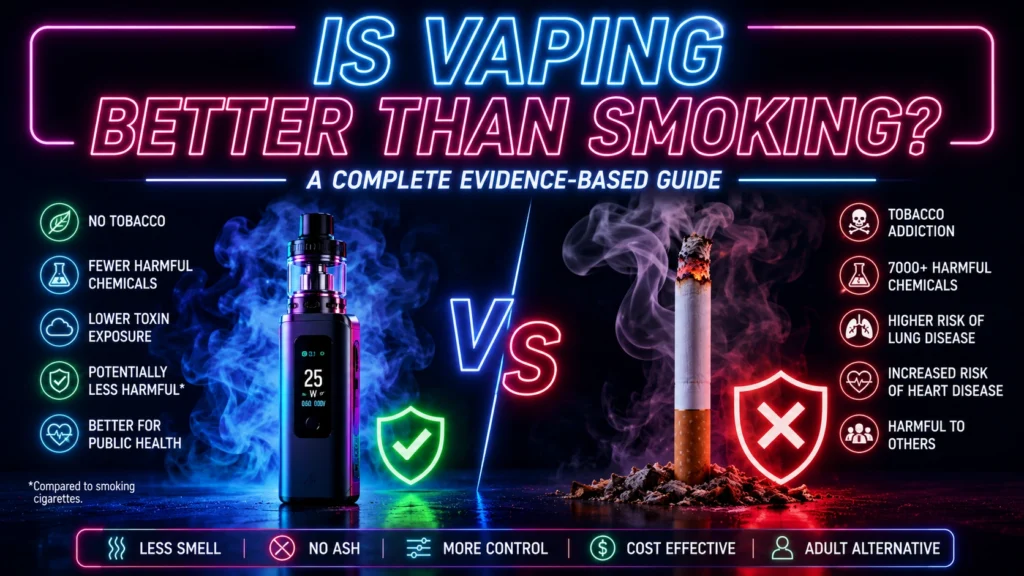
When people ask, “Is vaping better than smoking?”, they are usually trying to determine which option causes less harm. While both activities involve inhaling substances into the lungs, the way they work is dramatically different. Traditional cigarettes burn tobacco through combustion, creating smoke that contains thousands of chemicals. Vapes, on the other hand, heat a liquid to create an aerosol that users inhale. This difference may seem small, but it changes the entire health equation.
Smoking has been studied for decades, and the evidence is overwhelming. Cigarette smoke contains more than 7,000 chemicals, many of which are toxic and cancer-causing. The burning process creates tar, carbon monoxide, and numerous harmful compounds that directly damage the lungs, heart, and blood vessels. Vaping eliminates combustion, which significantly reduces exposure to many of these dangerous substances. However, reduced exposure does not mean zero risk.
The growing popularity of vaping has sparked debates among doctors, researchers, and public health organizations worldwide. Some health experts view vaping as a harm-reduction tool for smokers, while others worry about long-term consequences that are not yet fully understood. The truth lies somewhere in the middle. Understanding the science behind both products is essential before making any health decisions.
Why This Debate Matters More Than Ever
The vaping industry has expanded rapidly over the last decade. Millions of adults worldwide now use e-cigarettes, and many smokers have switched from traditional tobacco products. At the same time, concerns have emerged regarding youth vaping, nicotine addiction, and potential long-term health effects. This makes the question of whether vaping is better than smoking more relevant than ever before.
One reason the debate remains active is that smoking-related diseases continue to kill millions of people globally every year. Health authorities consistently identify smoking as one of the leading preventable causes of death. Because smoking is so harmful, any alternative that reduces exposure to toxic chemicals naturally attracts attention from researchers and policymakers.
Recent health reviews suggest that vaping exposes users to fewer toxic substances than smoking because it avoids burning tobacco. Public health experts in the United Kingdom have repeatedly stated that vaping poses only a fraction of the risk associated with smoking, particularly when smokers switch completely rather than using both products simultaneously.
Still, vaping is not a health product. It is important to remember that most e-cigarettes contain nicotine, which is highly addictive. The challenge for consumers is understanding the difference between “less harmful” and “safe.” Those two terms are not interchangeable, and confusing them can lead to poor decisions.
What Happens Inside Your Body When You Smoke
Smoking cigarettes is like running a dirty factory inside your lungs. Every puff introduces a complex mixture of toxic chemicals that spread throughout the body. These chemicals enter the bloodstream within seconds and begin affecting nearly every organ.
The biggest problem comes from combustion. When tobacco burns, it creates tar, carbon monoxide, formaldehyde, benzene, arsenic, and dozens of other harmful substances. Many of these compounds are known carcinogens, meaning they can cause cancer. Others damage blood vessels, increase inflammation, and reduce oxygen delivery throughout the body.
The damage accumulates over time. Smokers face higher risks of lung cancer, chronic obstructive pulmonary disease (COPD), heart disease, stroke, and numerous respiratory illnesses. Even occasional smoking can negatively affect cardiovascular health. The body’s natural defense mechanisms struggle to keep up with the constant assault of toxic particles and gases.
Think of your lungs as a sophisticated air filtration system. Cigarette smoke clogs and damages that system repeatedly. Over years of exposure, the damage becomes increasingly difficult to reverse. This is why smoking remains one of the most dangerous legal consumer habits worldwide and why researchers continue searching for less harmful alternatives.
What Happens Inside Your Body When You Vape
Unlike cigarettes, vaping does not involve burning tobacco. Instead, a battery-powered device heats a liquid that usually contains nicotine, flavorings, propylene glycol, and vegetable glycerin. This heated liquid creates an aerosol that users inhale.
The absence of combustion significantly changes the chemical profile of what enters the body. Most harmful substances associated with cigarette smoke, including tar and carbon monoxide, are largely absent in properly regulated vaping products. This reduction in toxic exposure is one reason many health organizations acknowledge vaping as a less harmful alternative for adult smokers.
However, vaping is far from harmless. Research shows that vape aerosol may contain nicotine, heavy metals, volatile organic compounds, and potentially harmful flavoring chemicals. Scientists are still investigating the long-term impact of inhaling these substances over decades. The lungs were not designed to process heated aerosols regularly, and concerns remain about respiratory and cardiovascular effects.
Nicotine itself presents additional challenges. It increases heart rate, raises blood pressure, and creates strong dependence. Young people are particularly vulnerable because nicotine can affect brain development. For non-smokers, starting to vape introduces health risks that would otherwise be avoided entirely. This is why health experts consistently advise non-smokers not to begin vaping.
Vaping vs Smoking: A Side-by-Side Comparison
| Factor | Smoking | Vaping |
| Tobacco Combustion | Yes | No |
| Tar Exposure | High | Minimal |
| Carbon Monoxide | High | Minimal |
| Cancer-Causing Chemicals | Thousands | Significantly Fewer |
| Nicotine Addiction | Yes | Usually Yes |
| Long-Term Research | Extensive | Limited |
| Lung Disease Risk | Very High | Lower but Present |
| Heart Disease Risk | Very High | Lower but Present |
| Suitable for Non-Smokers | No | No |
This comparison highlights why many researchers consider vaping less harmful than smoking. The removal of combustion dramatically reduces exposure to some of the deadliest chemicals found in cigarette smoke. Yet every category still contains some level of risk.
Cost is another factor people often consider. Depending on usage habits and local prices, vaping may cost less than smoking over time. However, financial savings should never be the primary reason for choosing one nicotine product over another. Health outcomes matter far more than monthly expenses.
The key takeaway is simple: if someone currently smokes cigarettes, switching completely to vaping may reduce harm. If someone does not smoke, starting to vape offers no health advantage whatsoever.
Is Vaping Safer Than Smoking?
Based on current evidence, the answer is generally yes. Most major health organizations agree that vaping exposes users to fewer toxic chemicals than smoking traditional cigarettes. The reduction comes primarily from eliminating tobacco combustion, which is responsible for many smoking-related diseases.
The UK National Health Service states that vaping is less harmful than smoking and can help smokers quit. Research reviews have concluded that vaping presents only a small fraction of the risks associated with smoking in the short and medium term. People who switch entirely from cigarettes to vaping often show reduced exposure to toxins linked to cancer, heart disease, stroke, and respiratory illnesses.
At the same time, the scientific community remains cautious. Long-term data covering multiple decades simply does not exist yet. Cigarettes have been studied extensively for generations, while modern vaping products are relatively new. Researchers continue monitoring health outcomes to determine whether additional risks emerge over time.
A useful analogy is comparing a severe storm to a smaller storm. The smaller storm may cause less damage, but it is still a storm. Vaping appears less harmful than smoking according to current evidence, but avoiding both remains the healthiest option available.
Can Vaping Help You Quit Smoking?
Many smokers turn to vaping as a smoking cessation tool. The reason is understandable. Vaping replicates some behavioral aspects of smoking, including the hand-to-mouth motion, inhalation sensation, and nicotine delivery. This familiarity can make the transition away from cigarettes easier for some individuals.
Research suggests vaping can help certain smokers quit combustible tobacco. The NHS notes that smokers using vaping products alongside professional support often achieve higher quit rates than those relying solely on traditional nicotine replacement therapies. Some evidence even indicates that vaping may outperform nicotine patches and gum for certain users.
Success depends heavily on complete switching. Many smokers fall into the trap of dual use, continuing to smoke cigarettes while vaping simultaneously. This approach significantly reduces potential health benefits because exposure to cigarette toxins remains. Health authorities consistently emphasize that complete replacement is necessary to maximize harm reduction.
People who successfully quit smoking through vaping are generally encouraged to reduce nicotine levels gradually and eventually stop vaping as well. The ultimate goal should always be freedom from nicotine dependence rather than simply replacing one delivery system with another indefinitely.
Risks of Dual Use
Dual use refers to using both cigarettes and vaping products at the same time. Unfortunately, this practice is extremely common among smokers attempting to transition. Many people assume that smoking fewer cigarettes automatically eliminates most health risks, but the reality is more complicated.
Research suggests dual users may still experience substantial exposure to harmful chemicals. Because cigarette smoking continues, the body remains exposed to carcinogens, carbon monoxide, and toxic combustion products. Some evidence even suggests that dual use may worsen respiratory outcomes compared with using either product alone.
Psychologically, dual use can also prolong nicotine addiction. Instead of moving away from tobacco, users maintain dependence through multiple sources. This makes quitting more difficult and can create a false sense of security regarding health risks.
Anyone considering vaping as a smoking cessation strategy should understand this crucial point: the greatest benefits occur when smoking stops entirely. Using both products together is like trying to drain a flooded boat while continuing to pour water inside.
Long-Term Health Concerns
One of the biggest unanswered questions surrounding vaping involves long-term health effects. Scientists have decades of smoking data but far less information about people who vape for 20 or 30 years. This uncertainty creates understandable concern among healthcare professionals.
Current research suggests vaping exposes users to fewer harmful chemicals than cigarettes, but exposure still occurs. Studies have identified heavy metals, ultrafine particles, and potentially harmful compounds in some vape aerosols. Researchers are investigating whether these exposures could contribute to future lung disease, cardiovascular problems, or other chronic conditions.
Disposable vape products have attracted particular scrutiny. Some studies have reported elevated levels of metals in certain devices, raising questions about manufacturing standards and product safety. These findings highlight the importance of regulation and quality control within the vaping industry.
Despite uncertainties, most experts agree on one important point: smoking remains significantly more dangerous based on available evidence. The long-term unknowns surrounding vaping should encourage caution, not complacency. Users should avoid interpreting “less harmful” as a guarantee of safety.
Who Should Avoid Vaping Completely?
While vaping may offer harm reduction benefits for adult smokers, there are several groups who should avoid it entirely.
These include:
- Children and teenagers
- Non-smokers
- Pregnant women
- People with certain cardiovascular conditions
- Individuals sensitive to nicotine
Health authorities consistently warn that youth vaping poses unique risks because developing brains are especially vulnerable to nicotine addiction. Nicotine exposure during adolescence can affect attention, learning, memory, and impulse control.
For non-smokers, vaping provides no meaningful health benefit. Starting a nicotine habit where none existed before only introduces unnecessary risks. The healthiest choice for these individuals is simple: avoid both smoking and vaping altogether.
Adults who already smoke represent a different situation. For them, switching completely from smoking to vaping may reduce exposure to harmful toxins. Even then, the long-term goal should remain nicotine cessation whenever possible.
Conclusion
The question “Is vaping better than smoking?” does not have a simple yes-or-no answer, but current scientific evidence points in a clear direction. Vaping appears to be significantly less harmful than smoking because it eliminates tobacco combustion and reduces exposure to many dangerous chemicals. Major health organizations acknowledge this difference and recognize vaping as a potential harm-reduction tool for adult smokers.
Less harmful does not mean harmless. Vaping still exposes users to nicotine and other potentially harmful substances, and researchers continue studying its long-term effects. For smokers unable to quit nicotine entirely, switching completely to vaping may offer health benefits compared to continuing cigarette use. For non-smokers, there is no reason to start vaping.
The healthiest path remains unchanged: avoid smoking, avoid vaping, and eliminate nicotine dependence whenever possible.
FAQs
1. Is vaping 100% safe?
No. Vaping is generally considered less harmful than smoking, but it is not risk-free and can still affect lung and cardiovascular health.
2. Does vaping cause cancer?
Current evidence suggests vaping exposes users to fewer carcinogens than smoking, but researchers are still studying long-term cancer risks.
3. Can vaping help people quit smoking?
Yes. Some studies indicate vaping can help smokers quit, especially when combined with professional cessation support.
4. Is secondhand vape exposure dangerous?
Secondhand vape aerosol appears less harmful than cigarette smoke, but it can still contain nicotine and other substances.
5. Which is worse: smoking or vaping?
Based on current evidence, smoking is generally considered more harmful because it exposes users to significantly higher levels of toxic and cancer-causing chemicals.
Categories
- 0mg Disposable Vape2 products
- 120ml E-liquid5 products
- 20 MG NICOTINE5 products
- 20Mg Disposable Vape27 products
- 50Mg Disposable Vape28 products
- 60ml E-liquid7 products
- AAOK Vape1 product
- Adalya Vape2 products
- Air Bar Vape3 products
- Al Fakher Vape3 products
- Battery for Vape3 products
- Beco Vape in Dubai1 product
- Blvk Vape1 product
- Disposable Vape68 products
- Disposable vape dubai20 products
- Dr Vapes1 product
- E-liquid22 products
- Elf Bar Disposable6 products
- Featured Product1 product
- Flash Deals2 products
- Flonq Vape1 product
- Fummo Vape2 products
- Geekvape13 products
- HQD Vapes2 products
- IGNITE Vape3 products
- Keif Vape1 product
- Lion King Vape2 products
- Lost Mary Vape1 product
- Maskking Vape1 product
- Mazaya Vape1 product
- MFU Vape1 product
- Misjoy Vape1 product
- Mosmo Vape1 product
- Myle6 products
- Myle V4 Series2 products
- Myle V5 Meta2 products
- Nasty Vape4 products
- Nerd Vapes1 product
- New Arrivals129 products
- Offer2 products
 Online Vape Shop144 products
 - Oxbar Vape1 product
- Oxva Vape17 products
- Pod Devices41 products
- Pod salt disposable10 products
- Pod System52 products
- Pods Cartridge28 products
- Relx Vape3 products
- Rifbar Vape2 products
- Ripe Vapes3 products
- SaltNic E-liquid10 products
- Shisha Disposable Vape9 products
- Sikary Vape2 products
- Silvaper1 product
- Smok Vape2 products
- Smooth Disposable1 product
- Sprk Vapor2 products
- Teslacig Vape1 product
- Tokyo E-juice4 products
- Tugboat disposable3 products
- Uwell Vape29 products
- Vape Coils12 products
- Vapengin Vape2 products
- Vapes Bars1 product
- Vaporesso Vape28 products
- Vgod Vape2 products
- VNSN Vape1 product
- Voopoo Vape15 products
- Vozol Vape3 products
- Waka Vape1 product
- Xtra Vape1 product
- Yuoto disposable2 products
- Zgar Vape1 product
Recents Post