
Blog
The Important Aspects of Where Nicotine Comes From
If you have made the switch from smoking to vaping, chances are you thought carefully about what you were putting into your body. Vaping was appealing because it offered a familiar nicotine experience without the smoke, tar, and thousands of toxic chemicals found in cigarettes.
But once you start vaping, it is natural to want to go deeper. What exactly is nicotine? Where does it come from? What type of nicotine is in your vape device? And does the source of nicotine actually make a difference to your experience?
In this blog, we answer all of these questions in plain, straightforward language so you can vape with full knowledge of what you are consuming.
What Is Nicotine?
Nicotine is a naturally occurring chemical compound found primarily in tobacco leaves. It is made up of carbon, hydrogen, and nitrogen. Nicotine is well known for two things — its ability to stimulate the brain and improve mood, and its highly addictive properties.
Humans have been consuming nicotine for an extraordinarily long time. Archaeological evidence suggests that Native American cultures were smoking tobacco more than 12,000 years ago. The tobacco plant is native to the Americas and has played a significant role in human history across many cultures.
Vaping, by contrast, is a very recent development. It has only been widely available and popular for the past couple of decades. But the nicotine that powers modern vaping products still originates from the same ancient plant that humans have relied on for thousands of years.
Understanding nicotine what it is and where it comes from helps you make smarter choices about the products you use and the nicotine strengths you choose.
Where Does Nicotine in E-Liquids Come From?
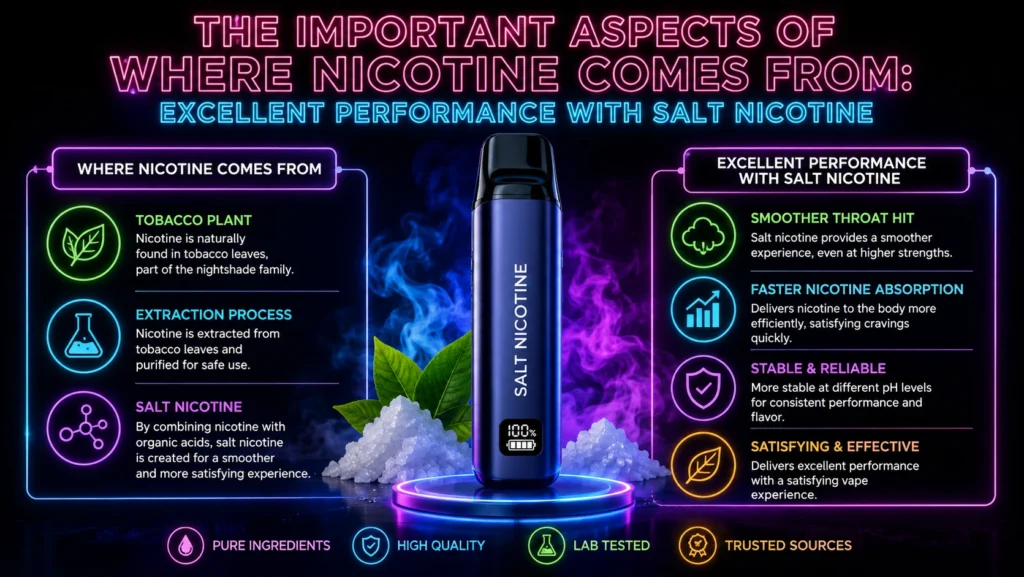
The nicotine used in vaping e-liquids is extracted from tobacco plants. The extraction process involves the use of alkaline solvents, which pull nicotine out of the tobacco leaves and produce what is known as freebase nicotine.
Freebase nicotine was the standard form of nicotine used in all e-liquids from the very beginning of vaping until the mid-2010s. It is effective but comes with one significant drawback at higher concentrations, freebase nicotine causes a harsh and uncomfortable throat hit. This was a major barrier for smokers trying to switch to vaping, because smaller devices like disposable vapes need higher nicotine concentrations to deliver satisfying results.
If the nicotine causes throat irritation at the strengths needed to satisfy a smoker, many people simply go back to cigarettes. This is the problem that nicotine salt was developed to solve.
What Is Nicotine Salt and Where Does It Come From?
Nicotine salt, commonly called salt nic, was developed in the mid-2010s as a direct solution to the throat-hit problem of freebase nicotine. The science behind it is actually quite simple.
Freebase nicotine is relatively alkaline. When you add a small amount of acid — typically benzoic acid — to freebase nicotine, the pH level drops and the nicotine molecules change their form. They become a salt compound rather than a freebase compound.
This change has two important effects:
Smoother throat hit: Because salt nicotine is less alkaline than freebase nicotine, it causes far less irritation to the throat even at high concentrations. You can vape at 40 to 50 mg/ml without the harshness that would make freebase nicotine at those levels unbearable.
Faster absorption: Nicotine salt is absorbed into the bloodstream more quickly than freebase nicotine. This faster delivery produces a satisfaction response that closely mimics the feeling of smoking a cigarette, which is why it became so popular among people making the switch from smoking.
The development of nicotine salt transformed the vaping industry. It made high-nicotine vaping comfortable and accessible, which opened the door for a new generation of small, simple devices — including the disposable vapes and pod systems that dominate the UAE market today.
You can explore a wide selection of quality saltnic e-liquid options on vapzone.ae, all sourced from trusted manufacturers and fully compliant with UAE regulations.
The Four Types of Nicotine Found in E-Liquids
Most vapers assume there are only one or two types of nicotine in e-liquids. In reality, there are four distinct categories. Understanding each one helps you make a more informed decision when choosing your products.
1. Freebase Nicotine Derived From Tobacco
This is the original and most traditional form of nicotine used in e-liquids. It is extracted directly from tobacco plants using an alkaline solvent process. Freebase nicotine works well at lower concentrations and is commonly found in sub-ohm e-liquids designed for larger, high-powered vaping devices.
For vapers who use direct-to-lung devices and prefer large vapor clouds over high nicotine strength, freebase nicotine is still the standard choice. It is typically available in strengths of 3 mg/ml to 12 mg/ml.
2. Nicotine Salt Derived From Tobacco
This is the most popular form of nicotine found in modern disposable vapes and pod systems. As explained above, it is freebase nicotine that has been treated with acid to lower its pH and create a smoother, faster-absorbing salt compound.
Salt nicotine is the driving force behind the popularity of devices like the Elf Bar 10000 Puffs and other high-puff disposable vapes. It allows these compact devices to deliver high nicotine satisfaction smoothly and comfortably, making them ideal for smokers switching to vaping.
3. Synthetic Freebase Nicotine
Synthetic nicotine is produced in a laboratory rather than extracted from tobacco plants. It is chemically identical to tobacco-derived freebase nicotine in terms of its molecular structure and effects on the body. However, because it does not originate from tobacco, it is technically classified differently under some regulatory frameworks.
Synthetic freebase nicotine is used by some manufacturers who want to create products that are technically tobacco-free. The vaping experience it delivers is virtually indistinguishable from tobacco-derived freebase nicotine.
4. Synthetic Nicotine Salt
This is the synthetic equivalent of tobacco-derived nicotine salt. Like synthetic freebase nicotine, it is created in a laboratory and does not come from tobacco plants. It delivers the same smooth throat hit and fast absorption as tobacco-derived salt nic but is marketed as a tobacco-free alternative.
Synthetic nicotine salt is becoming increasingly common in the vaping industry as manufacturers look for ways to produce consistent, high-purity nicotine outside of the tobacco supply chain.
How to Find Out What Type of Nicotine Is in Your Device
Now that you know the four types of nicotine used in e-liquids, you might be wondering which one is in your current device. The answer is simpler than you might think.
Read the label: Most reputable vaping products clearly state the type and concentration of nicotine on the packaging. Look for terms like “nicotine salt,” “salt nic,” “freebase,” or “synthetic nicotine.” The nicotine strength in mg/ml will also be listed.
Check the product listing: If you purchase your vaping products online through vapzone.ae, the product description will include details about the type and strength of nicotine in the device or e-liquid.
Look at the device type: As a general rule, disposable vapes and pod systems almost always use nicotine salt. Larger sub-ohm devices and box mods typically use freebase nicotine e-liquids. This is not a universal rule, but it is a reliable starting point.
For example, if you are using a disposable vape from a trusted brand, the nicotine is almost certainly in salt form — specifically chosen to work well with the device’s low-wattage output and to deliver smooth, satisfying results.
Does the Source of Nicotine Affect Your Vaping Experience?
For most everyday vapers, the difference between tobacco-derived and synthetic nicotine is not noticeable in terms of flavor, throat hit, or satisfaction. Both forms are used in quality products and deliver comparable results.
What matters far more to your daily experience is the type of nicotine (freebase vs salt) and the concentration (mg/ml). These two factors have a direct and significant impact on how your vape feels and how satisfied you feel after each session.
Choosing the right nicotine type and strength for your device and your habits is the single most important factor in having a positive vaping experience.
Nicotine Strength Guide for Different Vapers
Choosing the right nicotine strength is just as important as understanding where nicotine comes from. Here is a simple guide:
Light or social smokers: 10 to 20 mg/ml salt nicotine is usually sufficient. This provides a mild but satisfying nicotine hit without being overwhelming.
Regular smokers (around half a pack a day): 20 to 35 mg/ml salt nicotine closely matches the nicotine intake of a regular smoker and is the most popular range for people switching from cigarettes.
Heavy smokers (a pack a day or more): 35 to 50 mg/ml salt nicotine is recommended. At this strength, the satisfaction response is strong enough to compete with the nicotine delivery of cigarettes.
You can find e-liquids and devices across this full range of strengths in the pod system category and disposable vape collections on vapzone.ae.
FAQs
Q1: Is the nicotine in vaping products the same as in cigarettes?
The nicotine itself is chemically the same. The key difference is how it is delivered. Cigarettes deliver nicotine through the combustion of tobacco, which also produces thousands of harmful chemicals. Vaping delivers nicotine through heated vapor without combustion, eliminating tar and most of the toxic byproducts associated with smoking.
Q2: What type of nicotine is in disposable vapes like Elf Bar?
Most disposable vapes, including the Elf Bar range, use nicotine salt. This is the preferred type for small, low-wattage devices because it delivers smooth, fast-absorbing nicotine without throat irritation at higher concentrations.
Q3: Is synthetic nicotine safer than tobacco-derived nicotine?
Both forms are considered comparable in terms of safety and effect. Synthetic nicotine is not derived from tobacco, which some manufacturers highlight as a selling point. However, the safety profile of nicotine in both forms is essentially the same.
Q4: How do I know what nicotine strength to choose?
Match your nicotine strength to your current smoking or vaping habits. Light users should start around 10 to 20 mg/ml. Regular users should try 20 to 35 mg/ml. Heavy users should consider 35 to 50 mg/ml. Adjust up or down based on how satisfied you feel after your first few sessions.
Q5: Where can I buy nicotine salt e-liquids and devices in Dubai?
You can find a comprehensive range of salt nicotine e-liquids, disposable vapes, and pod systems on vapzone.ae. All products are authentic, licensed, and available for fast delivery across Dubai and the UAE.
Final Thoughts
Nicotine has been a part of human culture for thousands of years. Today, it is delivered in more ways than ever before and understanding those ways helps you make smarter choices about your own vaping habits.
Whether your device uses tobacco-derived nicotine salt, freebase nicotine, or synthetic variants, what matters most is choosing a product from a trusted source that clearly labels its ingredients and meets UAE quality standards.
For a full range of authentic, clearly labeled vaping products including e-liquids, disposables, and pod systems, visit vapzone.ae your reliable vaping destination in Dubai and across the UAE.
Categories
- 0mg Disposable Vape2 products
- 120ml E-liquid5 products
- 20 MG NICOTINE5 products
- 20Mg Disposable Vape27 products
- 50Mg Disposable Vape28 products
- 60ml E-liquid7 products
- AAOK Vape1 product
- Adalya Vape2 products
- Air Bar Vape3 products
- Al Fakher Vape3 products
- Battery for Vape3 products
- Beco Vape in Dubai1 product
- Blvk Vape1 product
- Disposable Vape68 products
- Disposable vape dubai20 products
- Dr Vapes1 product
- E-liquid22 products
- Elf Bar Disposable6 products
- Featured Product1 product
- Flash Deals2 products
- Flonq Vape1 product
- Fummo Vape2 products
- Geekvape13 products
- HQD Vapes2 products
- IGNITE Vape3 products
- Keif Vape1 product
- Lion King Vape2 products
- Lost Mary Vape1 product
- Maskking Vape1 product
- Mazaya Vape1 product
- MFU Vape1 product
- Misjoy Vape1 product
- Mosmo Vape1 product
- Myle6 products
- Myle V4 Series2 products
- Myle V5 Meta2 products
- Nasty Vape4 products
- Nerd Vapes1 product
- New Arrivals128 products
- Offer2 products
 Online Vape Shop143 products
 - Oxbar Vape1 product
- Oxva Vape17 products
- Pod Devices41 products
- Pod salt disposable10 products
- Pod System52 products
- Pods Cartridge28 products
- Relx Vape3 products
- Rifbar Vape2 products
- Ripe Vapes3 products
- SaltNic E-liquid10 products
- Shisha Disposable Vape9 products
- Sikary Vape2 products
- Silvaper1 product
- Smok Vape2 products
- Smooth Disposable1 product
- Sprk Vapor2 products
- Teslacig Vape1 product
- Tokyo E-juice4 products
- Tugboat disposable3 products
- Uwell Vape29 products
- Vape Coils12 products
- Vapengin Vape2 products
- Vapes Bars1 product
- Vaporesso Vape28 products
- Vgod Vape2 products
- VNSN Vape1 product
- Voopoo Vape15 products
- Vozol Vape3 products
- Waka Vape1 product
- Xtra Vape1 product
- Yuoto disposable2 products
- Zgar Vape1 product
Recents Post